In-house or hired teleoperators for data collection: the costs compared
Once the rig works, the operator is most of the cost. The published pay ranges, the true employer cost, the published prices for hired collection and a way to compare them.
Contents
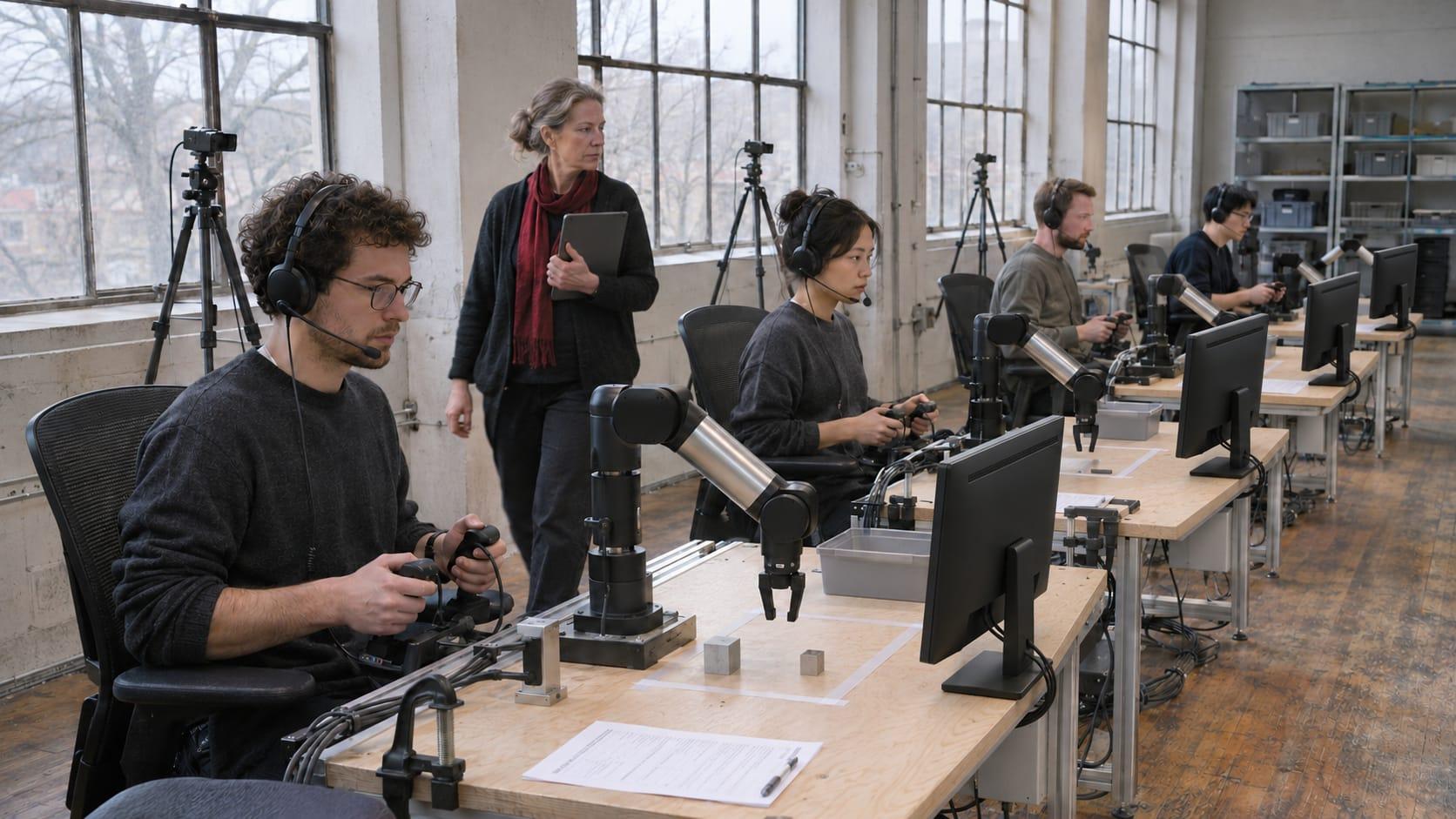
A team that has built its rig and written its protocol reaches the question it tends to leave for last: who sits at the controls, every day, for months. Hiring operators means recruiting, training and scheduling people for repetitive, skilled work. Buying the work means trusting someone else's people with the robot and the data. The decision is usually made on instinct, because the figures needed to compare the two are scattered. This guide collects them.
What operators are paid
The clearest evidence is what robotics companies offer in their own listings.
| Employer | Role | Published pay | Listing |
|---|---|---|---|
| Physical Intelligence | Robot Operator, San Francisco | $25 an hour | Posted August 20261 |
| 1X | Operator, Data Collection, San Carlos | $28 to $36 an hour | Posted September 20262 |
| Dyna Robotics | Data Collection Operator, Redwood City | $30 to $32 an hour | Posted May 20263 |
| Figure | Humanoid Robot Pilot, San Jose | $32 an hour | Read November 20264 |
| Tesla | Data Collection Operator, Palo Alto | $25.25 to $48 an hour | Reported August 20245 |
All five are in the San Francisco Bay Area, where pay is high. A vendor's benchmark guide puts base rates at $22 to $35 an hour across US regions, lower for remote and international operators6. RoboPilots' own reading of public listings for contract teleoperators is roughly $20 to $55 an hour, depending on country, skill and on-site requirements7.
What employment adds
The wage is not the cost. The US Bureau of Labor Statistics reports that in June 2026 employers in private industry paid an average of $46.89 per hour worked, of which wages and salaries were $32.82, or 70.0%, and benefits the remaining 30.0%8. Dividing a wage by 0.70 gives a first estimate of employer cost: $35.71 for a $25 wage, $42.86 for $30 and $51.43 for $36.
Three further costs sit outside that figure.
- Training. One vendor estimates that certifying a new operator costs about $3,000 in training time6. This is the vendor's estimate; no independent figure is published.
- Coverage. Tesla's listing described three eight-hour shifts5. Around-the-clock collection needs several people per station.
- Management. Someone writes the protocol, reviews episodes and plans shifts. In a small team that person is usually an engineer.
What hired collection costs
Published prices are scarce and describe different things.
| Provider | Published price | What the price buys |
|---|---|---|
| RoboPilots97 | From $12 an hour; the rest quoted on the fleet | Remote pilots trained on the customer's robot, with labeled episodes returned |
| AY-Robots10 | €49.99 or €299.99 a month; operators at €6 to €22 an hour | A marketplace plan plus independent operator time |
| OBI Services11 | "From $3+/Hour" in its page title; plans by quote | Outsourced remote operators for monitoring and teleoperation |
| Robotics Center12 | $2,500 for 20 demonstrations; $8,000 for 100 | Demonstrations collected in the vendor's lab, with task design and QA |
The first three are hourly prices for people and the fourth is a price per result. They cannot be compared directly. An hourly price becomes a price per episode only once throughput and pass rate are known, and those depend on the task. Robotics Center's prices work out to $125 and $80 a demonstration, which is far above what operator time alone would suggest, because they include the lab, the robot, the task design and the checks12.
RoboPilots lists the variables that move its quotes: coverage hours, how many robots one pilot handles, the skill the task needs, data labeling and integration work7. A starting price is the bottom of a range, and a quote for a dexterous task will sit above it.
What each model is good at
RoboPilots' guide describes four staffing models7.
- In-house operators. The most control and the deepest knowledge of the robot. The team carries recruiting, shifts and churn. It works best while the fleet is small and engineers sit beside the operators.
- Contract operators. Fast to start. The team still writes the training, the protocol and the checks, and turnover means retraining.
- Software-only platforms. The vendor supplies the teleoperation stack and the team supplies the people.
- Managed operators. The provider supplies trained operators, the schedule and the data pipeline. The team defines the task and the standard.
Two limits apply to any remote arrangement. Someone at the robot still has to reset the scene unless the task resets itself, and network delay constrains fast, contact-rich work. Direct manipulation feels close to natural under roughly 100 to 150 milliseconds of round trip, by RoboPilots' rule of thumb13.
Comparing them fairly
- Measure before comparing. Run a pilot batch and record episodes per hour and pass rate for the task.
- Compute the in-house cost per clean episode. Wage ÷ 0.70, plus the rig cost per hour, divided by clean episodes per hour. The main guide shows the arithmetic.
- Ask each provider for a trial on the same task. A one-week trial yields the provider's own throughput and pass rate, which is the only fair basis.
- Use the quoted rate, not the starting price. Add any on-site labour the remote model still needs.
- Add what the table leaves out. Training, supervision and the engineer's time on one side; integration and setup fees on the other.
- Revisit as the fleet grows. The answer for one robot is rarely the answer for ten.
The end state is a staffing decision that rests on one comparable number for each option, measured on the team's own task. Whichever option wins, the protocol and the checks stay with the team.
Questions buyers ask
How much are robot teleoperators paid?
US job listings read on November 11, 2026 show $25 an hour at Physical Intelligence, $28 to $36 at 1X, $30 to $32 at Dyna Robotics and $32 at Figure. Tesla's 2024 listing for data collection operators offered $25.25 to $48 an hour.
What does an in-house operator really cost per hour?
More than the wage. US Bureau of Labor Statistics figures for June 2026 put wages at 70.0% of private-industry compensation, so a $30 wage implies about $42.86 an hour in employer cost, before recruiting, training and supervision.
What do hired teleoperators cost?
Few providers publish prices. RoboPilots publishes a starting price of $12 an hour and quotes the rest. AY-Robots publishes operator rates of €6 to €22 an hour on top of a monthly plan. Robotics Center sells lab-collected demonstrations at $2,500 for 20.
Sources
- Robot Operator, San Francisco (job listing). Physical Intelligence, 6 Aug 2026. Accessed 11 Nov 2026.
- Operator, Data Collection (Swing Shift), San Carlos (job listing). 1X Technologies, 9 Sep 2026. Accessed 11 Nov 2026.
- Data Collection Operator, Redwood City (job listing). Dyna Robotics, 8 May 2026. Accessed 11 Nov 2026.
- Humanoid Robot Pilot, San Jose (job listing). Figure. Accessed 11 Nov 2026.
- Tesla is paying up to $48 per hour for data collection operators. Business Insider (Grace Kay), via AOL, 19 Aug 2024. Accessed 11 Nov 2026.
- Robot operator recruitment and training guide. Robotics Center, 7 Apr 2026. Accessed 11 Nov 2026.
- Robot teleoperation as a service: how it works and what it costs. RoboPilots, 11 Nov 2026. Accessed 11 Nov 2026.
- Employer Costs for Employee Compensation, June 2026. US Bureau of Labor Statistics, 9 Sep 2026. Accessed 11 Nov 2026.
- Robot teleoperation pricing. RoboPilots. Accessed 11 Nov 2026.
- Pricing. AY-Robots. Accessed 11 Nov 2026.
- Remote robot operators and robot monitoring services. OBI Services. Accessed 11 Nov 2026.
- Custom robot data collection services. Robotics Center. Accessed 11 Nov 2026.
- Teleoperation latency: how much delay each robot task tolerates. RoboPilots, 31 Oct 2026. Accessed 11 Nov 2026.
Updated 11 Nov 2026: First published.