Teleoperation rigs for data collection: leader arms, VR and handheld tools
The device in the operator’s hands decides what the dataset contains. The published evidence on four families of rig, with what each costs and records.
Contents
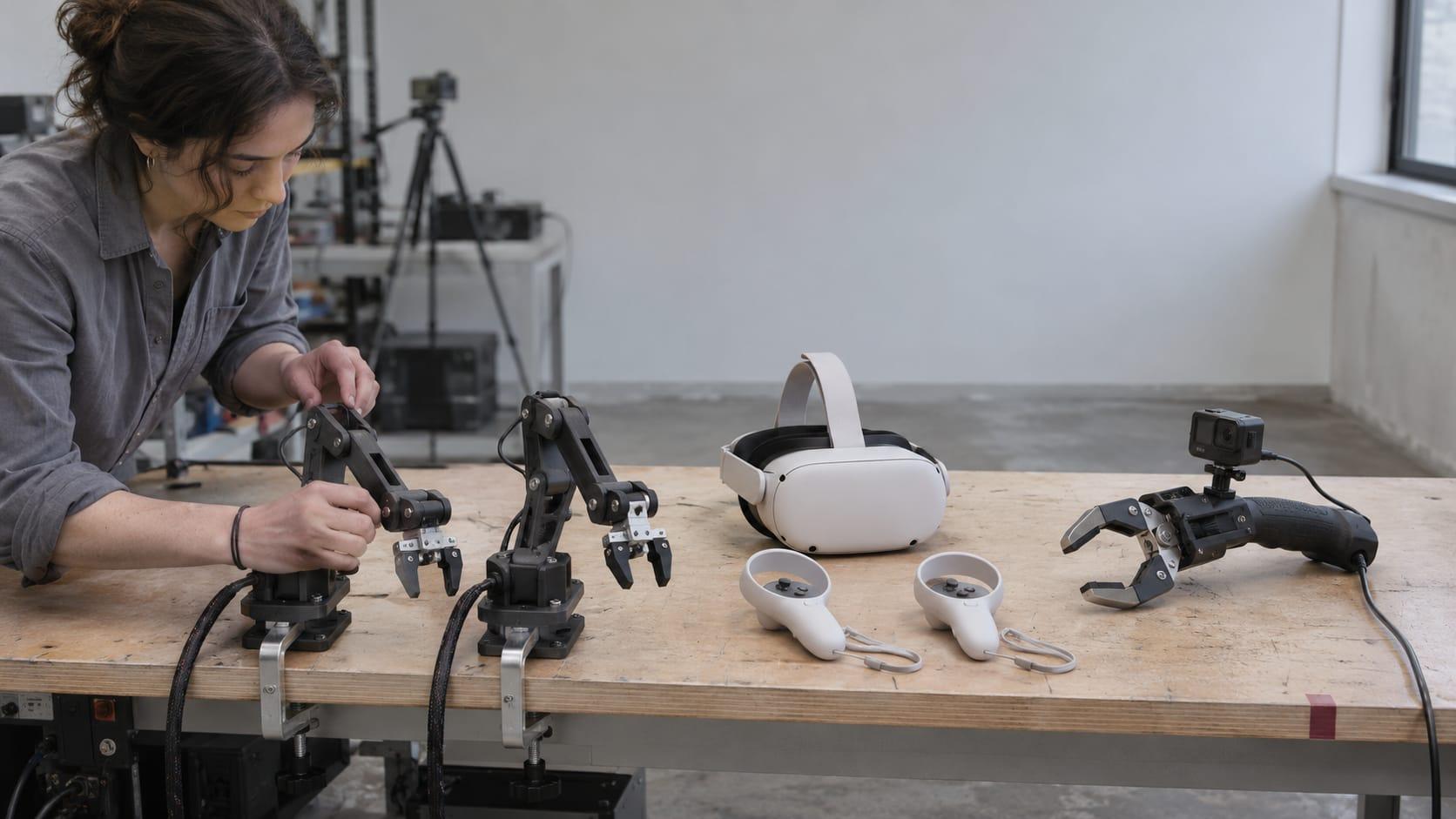
A team choosing a rig is choosing what its dataset will contain. A leader arm records joint angles, a headset records hand poses and a handheld gripper records a camera's view of a human hand at work. Each trains a policy, but they are not interchangeable, and a change of rig halfway through a collection splits the dataset in two.
Why the choice is hard to undo
A policy learns the actions it is shown. If half the episodes were driven by a leader arm and half by a 3D mouse, the motions differ in speed, smoothness and style even when the task is the same. RoboPilots' collection guide advises one interface per task family, kept fixed, for this reason1. The rig is therefore a decision to make once, on evidence.
Leader arms
A leader arm is a small kinematic copy of the robot that the operator moves by hand while the real arm follows. The actions it records are joint positions, the same space most policies output.
GELLO is the best-documented low-cost design. Its authors report a bill of materials under $300 per device and compare it with other interfaces in the same table: about $150 for a 3D mouse, $300 for a Quest 2 headset, $30,000 for a second robot used as a leader and $40,000 for a haptic device2. In their study of 12 participants and five tasks, GELLO users succeeded 92% of the time on average, against 72% with VR controllers and 63% with a 3D mouse, and completed tasks faster23.
The SO-101 design from TheRobotStudio lists parts for a leader and follower pair at $229.88 in the US, excluding printed parts by our reading of its table4. Seeed Studio sells a servo motor kit for the design at $249.90, which it states does not include 3D-printed parts or a camera5.
Complete bimanual kits
ALOHA put two leader-follower pairs and four cameras on one table. The paper reports that the whole system costs under $20,000 with off-the-shelf robots and 3D-printed parts, and that teleoperation and recording both run at 50 Hz6. Two cameras are fixed and two sit on the robots' wrists, each streaming at 480 by 6407. The authors also tested a slower rig: dropping teleoperation from 50 Hz to 5 Hz made operators 62% slower6.
Mobile ALOHA added a wheeled base and whole-body control within a $32,000 budget, which its authors compare to the price of a single industrial cobot8.
Commercial versions exist. On November 11, 2026, Trossen Robotics listed its Solo AI single-arm kit at $11,385.95, its Stationary AI bimanual kit at $23,995.95 and its Mobile AI kit at $33,695.95 without a laptop91011.
VR headsets
A headset tracks the operator's head and hands, maps them to the robot and shows the robot's cameras in stereo. It is the usual choice where the operator has to look around.
Open-TeleVision uses an Apple Vision Pro, streams stereo video at 480 by 640 per eye and runs its whole loop at 60 Hz12. DROID, the largest open manipulation dataset of its kind, used a Quest 2 headset with controllers to drive a Franka arm, and recorded three stereo camera streams at 15 Hz13. BridgeData V2 collected 50,365 demonstrations by teleoperating a low-cost arm with a VR controller at 5 Hz14. Apple lists the Vision Pro from $3,69915.
Remote VR operation is sensitive to delay. RoboPilots' latency guide puts natural-feeling direct manipulation under roughly 100 to 150 milliseconds of round trip16.
Handheld grippers, with no robot
The Universal Manipulation Interface is a handheld parallel-jaw gripper with a camera on it. A person does the task by hand, and the recording is transferred to a robot fitted with the same gripper and camera. The printed gripper costs $73 in parts and the camera and accessories $29817.
Its authors measured how many demonstrations one person could collect in 15 minutes by three methods, counting resets and robot faults. The hourly rates were 231 with a bare hand, 111 with the UMI gripper and 35 with a 3D mouse driving a robot1817. The trade is specificity. A handheld recording contains no robot joint states, and it suits tasks a gripper-and-wrist-camera view can describe.
Simulation and synthetic multiplication
Isaac Lab supports teleoperation in simulation with a keyboard, a SpaceMouse or an XR headset, and its tutorial has the user collect ten successful demonstrations and then generate 1,000 from them with its Mimic tool19. NVIDIA reports generating 780,000 synthetic trajectories in 11 hours, and a 40% improvement in its GR00T N1 model when synthetic data was combined with real data, compared with real data alone. Both figures are the company's own20.
Synthetic data multiplies human demonstrations. It does not remove the need for them, and the real ones still have to come from a rig.
The rigs side by side
| Rig | Published cost | Action recorded | Best suited to |
|---|---|---|---|
| GELLO leader2 | Under $300 in parts | Joint positions | Adding a leader to an arm a lab already owns |
| SO-101 pair4 | $229.88 in parts | Joint positions | Learning the workflow; low-payload tasks |
| ALOHA-style bimanual kit610 | Under $20,000 to build; $23,995.95 to buy | Joint positions, two arms, 50 Hz | Fine two-handed tabletop tasks |
| Mobile bimanual kit811 | $32,000 to build; from $33,695.95 to buy | Arms plus base motion | Tasks that involve moving through a room |
| VR headset1512 | From $3,699 for Vision Pro | Head and hand poses | Humanoids, dexterous hands, remote operators |
| UMI handheld17 | $73 plus $298 | Gripper pose from video | Fast collection in many places, no robot on site |
Choosing
- Start from the policy's action space. If the policy outputs joint targets, a leader arm records them directly.
- Match the embodiment. One arm, two arms, a mobile base or a humanoid each narrow the options to one or two.
- Decide where the operator sits. A leader arm needs the operator at the bench unless it is networked. A headset works from another room or another city.
- Budget for cameras and timing, not only the device. The recording half of the rig decides data quality.
- Run 50 episodes before buying more. Measure episodes per hour and the pass rate, then scale the rig that the numbers favour.
The end state is one rig per task family, documented and fixed, with every episode recorded through the same device at the same rate. The throughput and quality guide covers what to measure once it is running.
Questions buyers ask
What is the cheapest rig for teleoperation data collection?
The SO-101 design lists $229.88 in parts for a leader and follower arm pair, before 3D printing. A GELLO leader device for an existing arm costs under $300 in parts, according to its authors.
What does an ALOHA-style kit cost?
The original ALOHA paper reports a build cost under $20,000. Trossen Robotics sells a comparable Stationary AI kit for $23,995.95 and a mobile version from $33,695.95, as listed on November 11, 2026.
Can demonstrations be collected without a robot?
Yes, with a handheld gripper such as UMI, which records wrist-camera video and gripper motion and transfers it to a robot afterwards. The authors measured 111 demonstrations an hour against 35 for teleoperation with a 3D mouse. The data is less specific to one robot's body.
Sources
- How to collect teleoperation data for robot learning (LeRobot, RLDS, HDF5). RoboPilots, 9 Oct 2026. Accessed 11 Nov 2026.
- GELLO: a general, low-cost, and intuitive teleoperation framework for robot manipulators. arXiv (Wu, Shentu, Yi, Lin, Abbeel), 22 Sep 2023. Accessed 11 Nov 2026.
- GELLO project page. Wu et al.. Accessed 11 Nov 2026.
- SO-ARM100 and SO-101: bill of materials (README). TheRobotStudio (GitHub). Accessed 11 Nov 2026.
- SO-101 low-cost AI arm servo motor kit. Seeed Studio. Accessed 11 Nov 2026.
- Learning fine-grained bimanual manipulation with low-cost hardware (ALOHA). arXiv (Zhao, Kumar, Levine, Finn), 23 Apr 2023. Accessed 11 Nov 2026.
- ALOHA project page. Zhao et al.. Accessed 11 Nov 2026.
- Mobile ALOHA: learning bimanual mobile manipulation with low-cost whole-body teleoperation. arXiv (Fu, Zhao, Finn), 4 Jan 2024. Accessed 11 Nov 2026.
- Solo AI robotic machine learning kit. Trossen Robotics. Accessed 11 Nov 2026.
- Stationary AI robotic machine learning kit. Trossen Robotics. Accessed 11 Nov 2026.
- Mobile AI robotic machine learning kit. Trossen Robotics. Accessed 11 Nov 2026.
- Open-TeleVision: teleoperation with immersive active visual feedback. arXiv (Cheng, Li, Yang, Yang, Wang), 1 Jul 2024. Accessed 11 Nov 2026.
- DROID: a large-scale in-the-wild robot manipulation dataset. arXiv (Khazatsky, Pertsch et al.), 19 Mar 2024. Accessed 11 Nov 2026.
- BridgeData V2: a dataset for robot learning at scale (project page). UC Berkeley (Walke et al.), 24 Aug 2023. Accessed 11 Nov 2026.
- Buy Apple Vision Pro. Apple. Accessed 11 Nov 2026.
- Teleoperation latency: how much delay each robot task tolerates. RoboPilots, 31 Oct 2026. Accessed 11 Nov 2026.
- Universal Manipulation Interface: in-the-wild robot teaching without in-the-wild robots. arXiv (Chi et al.), 15 Feb 2024. Accessed 11 Nov 2026.
- Universal Manipulation Interface project page. Chi et al.. Accessed 11 Nov 2026.
- Teleoperation and imitation learning with Isaac Lab Mimic. Isaac Lab documentation (NVIDIA), 11 Nov 2026. Accessed 11 Nov 2026.
- NVIDIA announces Isaac GR00T N1. NVIDIA, 18 Mar 2025. Accessed 11 Nov 2026.
Updated 11 Nov 2026: First published.